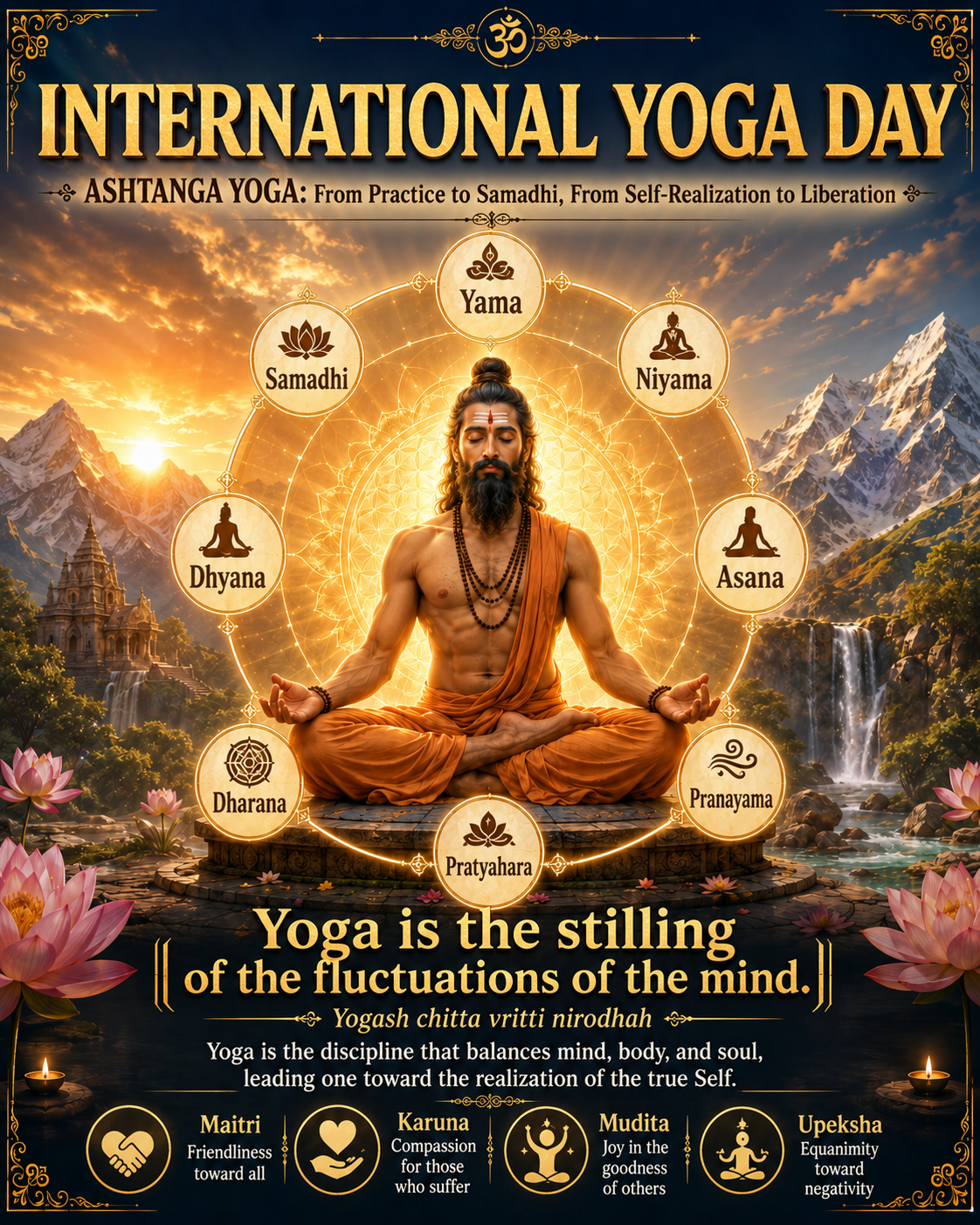
Ashtanga Yoga: The Sacred Journey from Purification of Chitta to Kaivalya and Moksha
A Special Reflection for International Yoga Day
Yoga is not merely the bending of the body, the performance of difficult postures, or sitting with closed eyes for a few moments. Yoga is a complete scientific, ethical, spiritual, and transformative discipline that refines the entire human personality. It leads us from physical steadiness to mental serenity, from intellectual clarity to inner awakening, and ultimately towards the realization of our true Self.
Maharishi Patanjali expresses the true essence of Yoga in one of the most profound and celebrated Sutras:
"Yogaś citta-vṛtti-nirodhaḥ"
Yoga is the regulation, mastery, and stilling of the modifications of Chitta.
Here, Nirodha does not mean forcibly suppressing the mind or making it blank. It means disciplining and transcending restlessness, misconception, attachment, distraction, and uncontrolled mental reactions, so that the individual may become established in pure awareness.
Maharishi Patanjali then declares:
"Tadā draṣṭuḥ svarūpe'vasthānam"
Then the Seer becomes established in its own essential nature.
When the disturbances of Chitta become quiet, the Draṣṭā—the witnessing Self—rests in its true Svarūpa. This is the inner purpose of Yoga—to rise beyond identification with the body, thoughts, emotions, status, possessions, and changing circumstances, and to realize the pure, luminous nature of the Self.
The Five Vrittis of Chitta
Maharishi Patanjali describes five principal modifications of Chitta. These may be Kliṣṭa, producing suffering and bondage, or Akliṣṭa, leading towards discernment, peace, wisdom, and liberation.
1. Pramāṇa — Valid Knowledge
Pramāṇa means true, reliable, and accurate knowledge. It arises through direct perception, proper inference, and trustworthy testimony or scriptural authority. True knowledge dispels ignorance and guides the mind towards right understanding.
2. Viparyaya — Misconception
Viparyaya means perceiving or understanding something in a manner contrary to its true nature. Much of human suffering arises not from reality itself, but from an incorrect perception of reality.
3. Vikalpa — Imagination or Conceptual Construction
Vikalpa is a mental construction that may not have any actual object or factual foundation. Excessive anxiety, imaginary fear, negative speculation, and baseless suspicion are expressions of Vikalpa. Yoga teaches us to distinguish between truth and mental projection.
4. Nidrā — Sleep
Sleep is also a modification of Chitta. During sleep, awareness of external objects is absent, yet Chitta continues to exist in a particular subtle condition. Sleep is not the complete absence of mental activity, but a distinct state of consciousness.
5. Smṛti — Memory
Smṛti is the reappearance in the mind of previously experienced objects, events, pleasures, pains, impressions, and Samskaras. Yoga teaches us to learn from memory without becoming imprisoned by it.
The Means of Calming the Vrittis of Chitta
Maharishi Patanjali prescribes two essential means: Abhyāsa and Vairāgya.
Abhyāsa — Sustained Practice
Abhyāsa is the repeated and sincere effort to establish the mind in truth, virtue, concentration, self-study, and inner steadiness. The fruits of Yoga unfold through disciplined practice sustained over a long period with faith, patience, devotion, and continuity.
Vairāgya — Non-Attachment
Vairāgya does not necessarily mean abandoning the world. It means living in the world without becoming enslaved by its attractions. Possessions may remain with us, but our consciousness should not become possessed by them.
Four Sublime Attitudes for a Peaceful and Joyful Chitta
Maharishi Patanjali gives four beautiful disciplines for purifying our reactions to others:
"Maitrī-karuṇā-muditopekṣāṇāṁ sukha-duḥkha-puṇyāpuṇya-viṣayāṇāṁ bhāvanātaś citta-prasādanam"
By cultivating friendship towards the happy, compassion towards the suffering, joy towards the virtuous, and wise equanimity towards those engaged in unwholesome conduct, Chitta becomes serene and gracious.
1. Maitrī towards the Happy and Successful
Towards those who are happy, prosperous, respected, or successful, we should cultivate friendliness and goodwill. Jealousy towards another's success burns our own heart.
2. Karuṇā towards the Suffering and Deprived
Towards those who are poor, ill, distressed, or deprived, we should cultivate compassion. To recognize their pain, protect their dignity, and serve them with respect is Yoga in action.
3. Muditā towards the Learned and Virtuous
Towards those who are learned, noble, and disciplined, we should cultivate joy and appreciative delight. Honouring the wise does not diminish our knowledge; it expands it.
4. Upekṣā towards Unwholesome Conduct
Towards those repeatedly engaged in injustice or deceit, we should cultivate wise equanimity. It means opposing injustice when necessary without allowing hatred and vengeance to consume our inner peace.
Ashtanga Yoga: From Outer Discipline to Inner Liberation
Maharishi Patanjali presents eight interconnected limbs of Yoga, collectively known as Ashtanga Yoga. Each limb prepares the practitioner for the next and gradually refines conduct, discipline, body, breath, senses, mind, and consciousness.
1. Yama — Universal Ethical Restraints
Ahimsā, Satya, Asteya, Brahmacharya, Aparigraha — five principles that purify our conduct towards other beings, society, and the world.
2. Niyama — Personal Discipline
Śaucha, Santoṣa, Tapas, Svādhyāya, Īśvara-Praṇidhāna — refine our personal and inner life.
3. Āsana — Steadiness and Ease
"Sthira-sukham-āsanam" — Āsana is a posture that is steady and easeful, preparing the body for meditation.
4. Prāṇāyāma — Regulation of Vital Energy
The conscious regulation of breath and vital energy. When breathing becomes calm, the mind also begins to settle.
5. Pratyāhāra — Withdrawal of the Senses
Freeing the senses from slavery to external objects and directing awareness inward.
6. Dhāraṇā — Concentration
Fixing the mind upon one chosen point, breath, sound, Mantra, or noble idea.
7. Dhyāna — Meditation
When the flow of Dhāraṇā becomes continuous and uninterrupted, it becomes Dhyāna.
8. Samādhi — Complete Absorption
The eighth and highest limb. The disturbances of Chitta become still, and consciousness shines in its own clarity.
Yoga, Kaivalya, and Moksha
The final purpose of Yoga is not merely freedom from illness, bodily flexibility, or stress reduction. The supreme purpose of Yoga is liberation from Avidyā (ignorance), Asmitā (ego-identification), Rāga (attachment), Dveṣa (aversion), and Abhiniveśa (fearful clinging to life).
In Patanjali Yoga Darshana, this supreme freedom is called Kaivalya—the complete establishment of consciousness in its own pure nature, free from the bondage of mental impressions, suffering, attachment, and identification with Prakṛti. This is spiritual freedom. This is Moksha.
A Resolve for International Yoga Day
On this International Yoga Day, let us not merely perform Yoga—let us live Yoga.
Let our thoughts embody Ahimsā. Let our words embody Satya. Let our actions embody Seva. Let our relationships embody Maitrī and Karuṇā. Let our breath lead us inward.
May Yoga unite humanity with health, harmony, wisdom, compassion, and the consciousness of universal oneness.
"Yogaś citta-vṛtti-nirodhaḥ" — "Tadā draṣṭuḥ svarūpe'vasthānam"
Yoga is not merely an exercise of the body—it is the awakening of the Self.
Om Shāntiḥ Shāntiḥ Shāntiḥ.
Share This Wisdom
Help spread the timeless wisdom of Ashtanga Yoga this International Yoga Day.
Explore Mitra →